


By Elvijs Plugis, published by Sigulp
Cover: AI-generated editorial illustration, not a photograph of Burberry premises or products.
A business can keep changing its marketing and make itself harder to buy from. Each campaign introduces a new promise, each sales conversation emphasises something different, and the customer is left to work out what the company actually does well. Before commissioning another reinvention, I would ask a simpler question: what do customers already have good reason to choose us for?
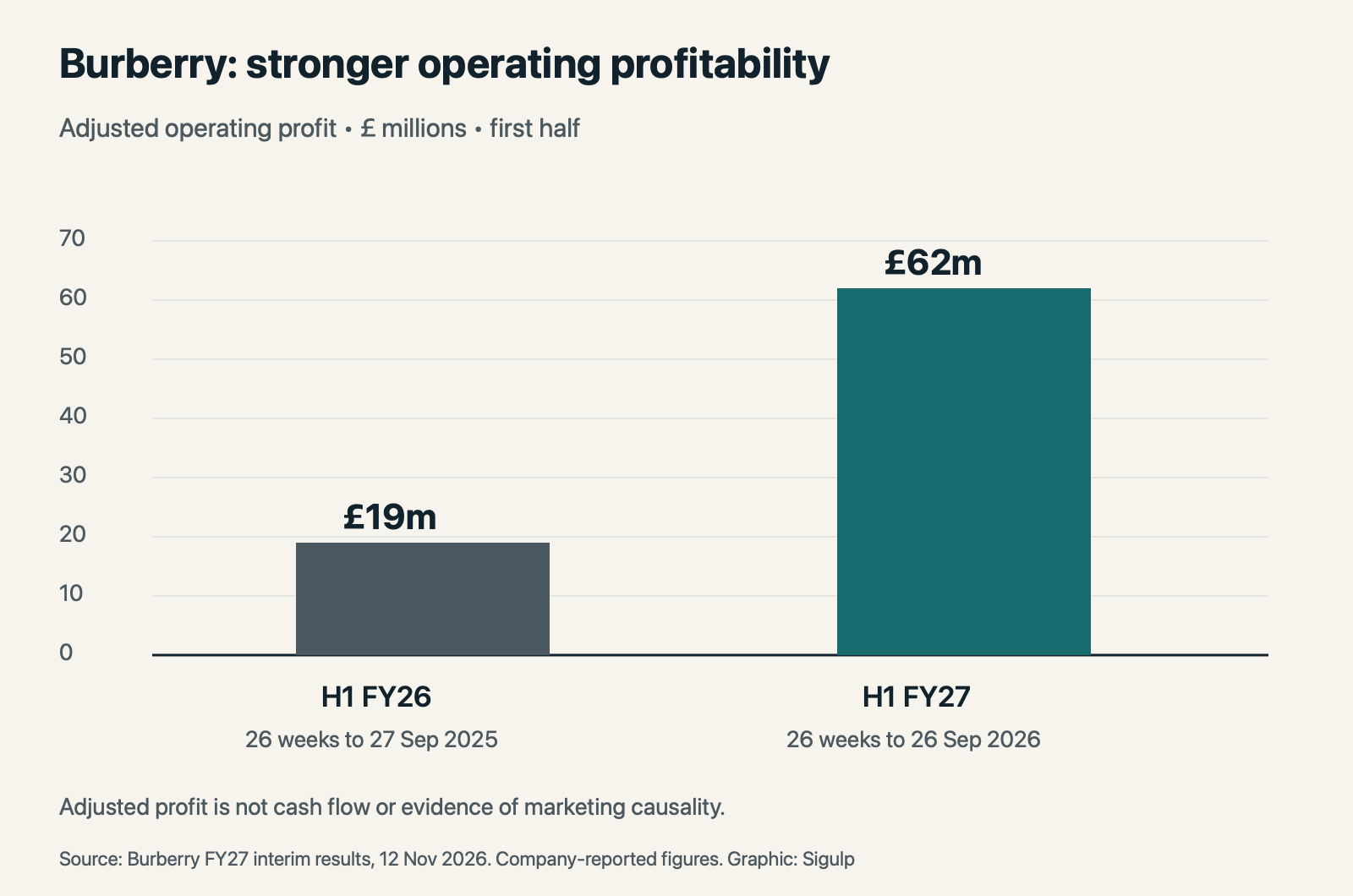
Burberry’s latest results make that question timely. On 12 November 2026, the company reported first-half comparable retail sales growth of 4% and adjusted operating profit of £62 million, up from £19 million. These figures concern the 26 weeks ended 26 September 2026. They show commercial progress, but they do not isolate the return from an advertising campaign. The useful lesson is how a recognisable strength can organise product, price, distribution and communication together.
The strategic correction behind the campaigns
In its November 2024 strategy announcement, Burberry described inconsistent execution, insufficient attention to core customers and a move away from its outerwear strengths. It also acknowledged that leather-goods pricing had not always matched its authority in that category. This was management’s diagnosis, rather than an independent experiment.
The response connected several decisions: emphasise outerwear and scarves, make familiar brand elements more visible, align pricing with category strength, improve presentation in stores and online, and coordinate creative and commercial teams. New imagery was part of a wider commercial change.
For a smaller company, the relevant question is not how to imitate a luxury campaign. It is whether the offer customers encounter supports the promise that brought them there. A specialist consultancy cannot credibly advertise every capability as equally distinctive. A manufacturer cannot build a reputation for dependable supply while its most promoted product is routinely unavailable.
Progress is evidence, not a complete explanation
Alliance News’s report on the latest results records growth across Burberry’s main product groups, double-digit outerwear growth and a mid-teens increase in e-commerce sales. First-half regional comparable sales ranged from growth in the Americas to a decline in Europe, the Middle East, India and Africa. The improvement was not uniform.
The company’s interim presentation also reports a £147 million free cash outflow. Sales, operating profit and cash therefore deserve separate attention. Costs, inventory, geography and trading conditions can move alongside marketing. It would be wrong to present these results as proof that a particular visual identity caused the recovery.
The case nevertheless offers a useful design principle: give the customer a coherent reason to choose you, and make the organisation capable of delivering it. That principle can be tested without a global advertising budget.
Start with earned strength, not the loudest claim
Over the next week, ask the person responsible for sales to review ten recent wins and five losses. Use quotations from actual conversations where permission and records allow. What problem brought the customer in? What made the final decision easier? What nearly stopped the purchase? Keep different customer groups separate.
Then compare those answers with contribution after delivery costs, repeat purchases and the team’s ability to fulfil the work. A frequently praised service may be unprofitable. A high-margin product may depend on one exceptional employee. Choose a strength supported by both customer evidence and operating reality. Fifteen conversations are a starting point, not a representative market survey.
Build one complete route from recognition to purchase
Take that strength through one customer journey. The campaign, landing page, proposal, price explanation and delivery promise should tell a consistent story. Give one commercial owner responsibility for checking the whole route with the people who fulfil the order.
For example, a hypothetical events-production business might be chosen for reliable delivery under tight deadlines. Instead of describing itself only as creative and innovative, it could show a documented production timetable, explain its contingency arrangements and offer a clearly scoped package. The evidence would support the positioning; the adjectives alone would not.
Start with existing material and staff time. A full website rebuild is unnecessary for a first test. Budget the actual hours needed to improve the proposal and supporting page, and check that the new promise does not create extra work the quoted price fails to cover.
Choose distribution for the buying decision
A channel should help the right customer assess and buy the offer. A specialist distributor, professional association or carefully selected event may provide useful context that broad social reach does not. Conversely, an intermediary’s commission or payment terms can make an apparently attractive route uneconomic.
For a 30-day trial, choose one audience and one route. Record qualified enquiries, proposals, wins, contribution and the time spent serving those customers. Compare with a relevant previous period while noting seasonal differences. For long sales cycles, track credible progress through the buying process rather than demanding immediate revenue.
Keep room for change
Consistency should not protect an offer whose market is disappearing. If customers no longer value the old strength, research a new use or audience rather than repeatedly polishing its presentation. Existing reputation is an asset only when it remains relevant.
Continue the trial when better-fit enquiries produce commercially worthwhile work. Change the offer if interest grows but objections remain consistent. Stop expanding the channel if acquisition and delivery costs consume the contribution. This is the connection between marketing activity and business benefit.
Burberry’s scale cannot be copied into a small business. Its underlying challenge is familiar: decide what deserves to be recognised, then align the business around making that choice worthwhile for the customer.

Elvijs Plugis is the founder and CEO of Sigulp. His expertise spans business strategy, strategic marketing, communications, partnerships and commercial development. Through Sigulp, he helps organisations connect strategy with practical delivery across marketing, PR and media, partnership development, events, advisory, commercial growth, and digital and AI discovery.
He also serves on the English Chamber Orchestra’s International Advisory Board, is a member of the Conservative Foreign & Commonwealth Council (CFCC), and is Vice Chair of the Parliamentary Society for Arts, Fashion and Sports.