


By Elvijs Plugis, published by Sigulp
When a business disappoints its customers, the next good sales result is welcome. It does not answer every question. Are customers buying again because the experience has improved, because a new product is attractive, or because switching would be inconvenient? Those explanations lead to different commercial decisions.
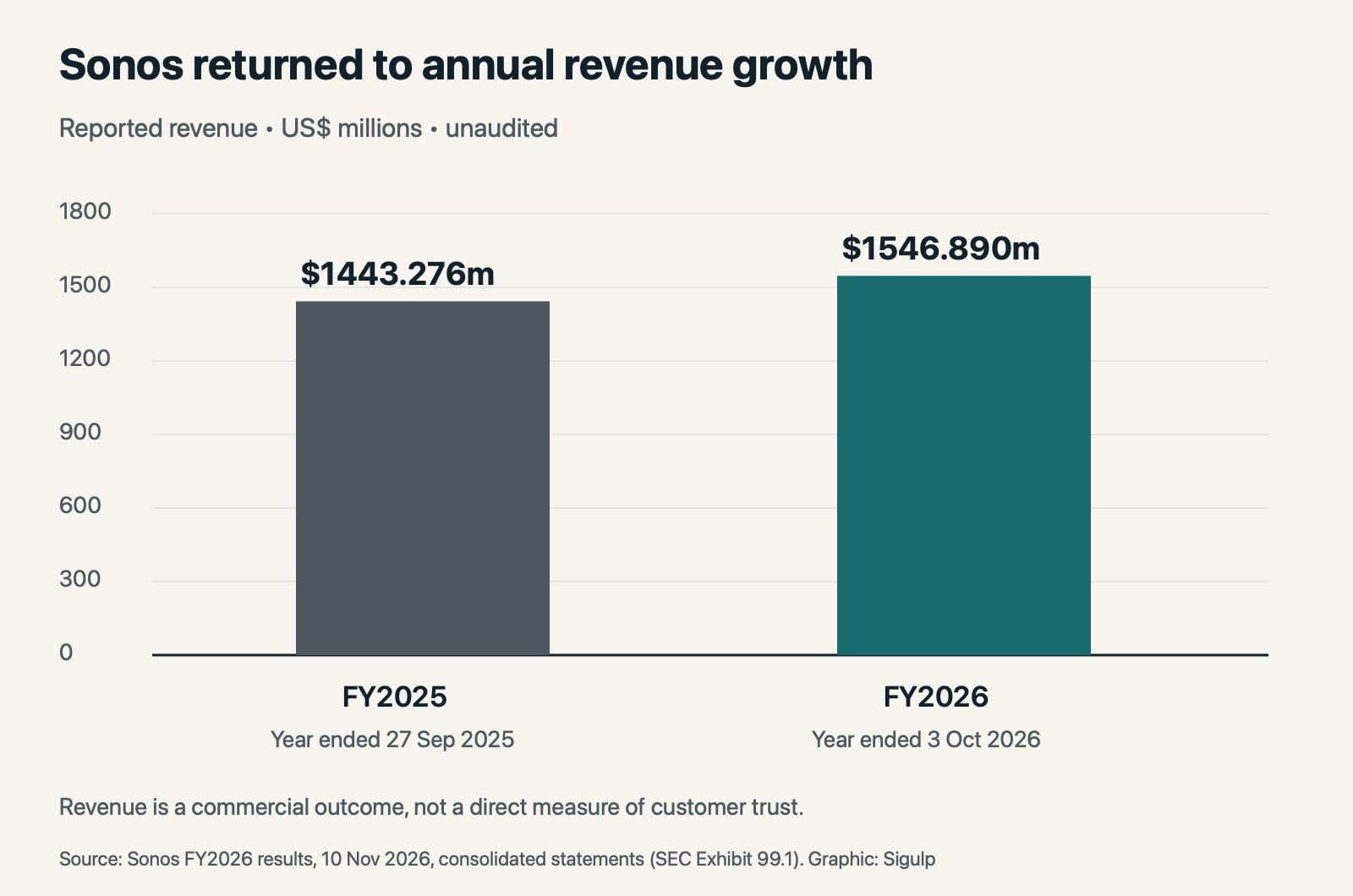
Sonos’s latest results make that distinction useful. The audio company reported on 10 November 2026 that annual revenue rose 7% to approximately $1.55 billion. That is progress. For owners rebuilding a service, product or reputation, the practical lesson is to measure recovery at the point where customers experience it, then connect that evidence to sales and profitability.
What the Sonos results establish
In its unaudited fiscal 2026 results, Sonos reported revenue of $1,546.890 million, compared with $1,443.276 million a year earlier. Annual operating cash flow reached approximately $145 million. Its $89.6 million net profit included $41.2 million of tariff refunds and $1.4 million of associated interest.
These figures describe financial performance, rather than providing a direct measure of customer trust. The refunds also matter when judging how much of the improvement represents repeatable operating performance. A business owner should welcome stronger results while remaining curious about what produced them.
A real recovery programme, with a longer history
There is a documented operational story behind the numbers. After its May 2024 app release, Sonos announced new quality and customer-experience commitments on 1 October 2024. These included broader testing, gradual releases of major changes, a quality ombudsperson and longer warranties for eligible speakers.
The significance was the connection between a public promise and the processes responsible for delivery. An apology can acknowledge a problem; a release gate, an escalation route and an accountable decision-maker can help prevent its return. The announcement documents what Sonos committed to do. It does not establish that each measure caused the subsequent revenue increase.
For a smaller business, the equivalent may be less technical: confirming an order before taking payment, checking an installation before leaving, or giving one person responsibility for resolving a complaint. Customers experience the reliability of these details long before they read a statement about improvement.
Satisfaction and recommendation can recover differently
Independent research adds another perspective. YouGov’s 2026 US consumer-electronics report, using historical data through December 2025, describes a gradual recovery in Sonos customer satisfaction after its 2024 decline, with recommendation harder to rebuild. The Sonos analysis uses current-customer responses, a base above 120 and a 26-week moving average.
This is US perception research, not a reading of worldwide customer sentiment today. YouGov also sells brand-tracking services. Nevertheless, the distinction is commercially useful: a customer may be willing to continue using something before feeling comfortable recommending it to a friend.
That gap matters for businesses relying on introductions. A professional adviser, events supplier or specialist installer may restore an existing relationship without immediately recovering the referrals that relationship once generated. A return to acceptable service and a return to active advocacy are different milestones.
Build a recovery test your team can actually run
A small business does not need a large research department to investigate this. It needs a clearly defined problem, a manageable group of affected customers and a consistent way to follow the result. I would start with three actions.
1. Fix one failure that has a measurable cost
Review the last month’s complaints, refunds and repeat support requests. Choose one recurring issue with a clear customer consequence. Assign an operational owner, record the current failure rate and set a two-week deadline for a small, testable change. Include staff time and rework in the cost, not only refunds.
For example, a hypothetical installation firm might address repeat visits caused by missing parts. Its measure would be installations completed correctly on the first visit, alongside the cost of return journeys. More enquiries would not demonstrate that this particular problem had been solved.
2. Follow the affected customers, rather than averaging everyone together
After the change, contact a small group of affected customers with a specific explanation of what has improved. Ask whether their original problem is resolved and whether another issue remains. Keep the group identifiable in the CRM so subsequent purchases and introductions can be tracked without confusing them with new customers.
Review responses weekly for 30 days. Where the buying cycle is longer, continue tracking rather than interpreting an absence of immediate purchases as failure. Use the findings to improve delivery, not to pressure customers into favourable reviews.
3. Set a condition for increasing marketing spend
Agree the decision before launching another campaign. For instance, expand promotion only after the selected service measure improves for two consecutive review periods without higher refunds or support costs. Track the contribution left after delivery and recovery costs, rather than celebrating revenue alone.
If sales rise but repeat problems return, pause the expansion and investigate. If service improves but buying does not, examine the offer, timing and customer need before spending more. The point is to learn which commercial constraint remains.
Keep the judgement proportional
Not every business needs a recovery programme, and a few complaints do not justify stopping all marketing. Seasonality, product launches, pricing and market conditions can change sales independently of service quality. Small customer groups also produce noisy results.
The sensible response is to combine customer evidence with operational and financial measures. Stronger sales tell us something important. Knowing why customers return, what it costs to serve them and whether they recommend the business tells us what to build next.

Elvijs Plugis is the founder and CEO of Sigulp. His expertise spans business strategy, strategic marketing, communications, partnerships and commercial development. Through Sigulp, he helps organisations connect strategy with practical delivery across marketing, PR and media, partnership development, events, advisory, commercial growth, and digital and AI discovery.
He also serves on the English Chamber Orchestra’s International Advisory Board, is a member of the Conservative Foreign & Commonwealth Council (CFCC), and is Vice Chair of the Parliamentary Society for Arts, Fashion and Sports.