


The next market worth entering may already be on a customer’s expansion plan. For a smaller business, understanding that plan can reveal a more credible growth opportunity than choosing a country from a list of fast-growing economies.
On 9 November 2026, logistics and industrial property group CTP announced agreed terms to acquire the Vietnamese portfolio and operating platform of South-East Asia Logistics Partners for approximately US$500 million. The proposed transaction remains subject to agreed conditions, including regulatory approvals, with completion expected in the coming months. CTP’s announcement sets out the terms.
The commercial reasoning deserves attention. Reuters reported that CTP’s chief executive linked the move to requests from customers seeking to expand beyond China and diversify their supply chains.
For small and medium-sized enterprises (SMEs), this suggests a practical approach: investigate customer demand and local delivery requirements before deciding how much capital to commit. That can shape a modest overseas service launch as well as a larger expansion.

Follow a purchasing decision
A customer entering a new country may need help with distribution, installation, maintenance, recruitment, marketing or operational support. An existing supplier should investigate whether its relationship and expertise can solve a specific part of that problem.
The strongest opportunity has a named buyer, an identifiable budget and a decision date. “We would like you involved” is a useful opening. A signed order or paid pilot, with scope and acceptance criteria, provides a firmer basis for allocating resources.
Existing trust can open the conversation, but the purchasing team abroad may have different requirements, established suppliers or no authority to buy from the current provider. Confirm which legal entity will contract, whether overseas procurement requires fresh supplier approval, and whether local certification or service standards differ.
Build the capability to deliver
CTP’s proposed acquisition includes seven operating properties, six development sites and the transfer of more than 55 employees across development, leasing and management. CTP says it had already entered Vietnam earlier in 2026. These details show the role of an established operating platform in its expansion plan. The company announcement explains the proposed transfer.
A smaller company can apply that principle through a qualified local partner, a distributor, a subcontracting arrangement or a small acquisition where the economics justify it.
Consider an illustrative example: a UK equipment-maintenance business serving a customer opening a Vietnamese facility. A qualified local service partner could make support possible. Before promising it, the supplier would need agreed response times, access to spare parts and confirmation that the local buying team can appoint it. This is a hypothetical SME example, not part of CTP’s announcement.
Local delivery should also survive a founder’s absence. Otherwise, every new customer adds another demand on the same person, and the apparent expansion can leave the business harder to run.
Five decisions before committing capital
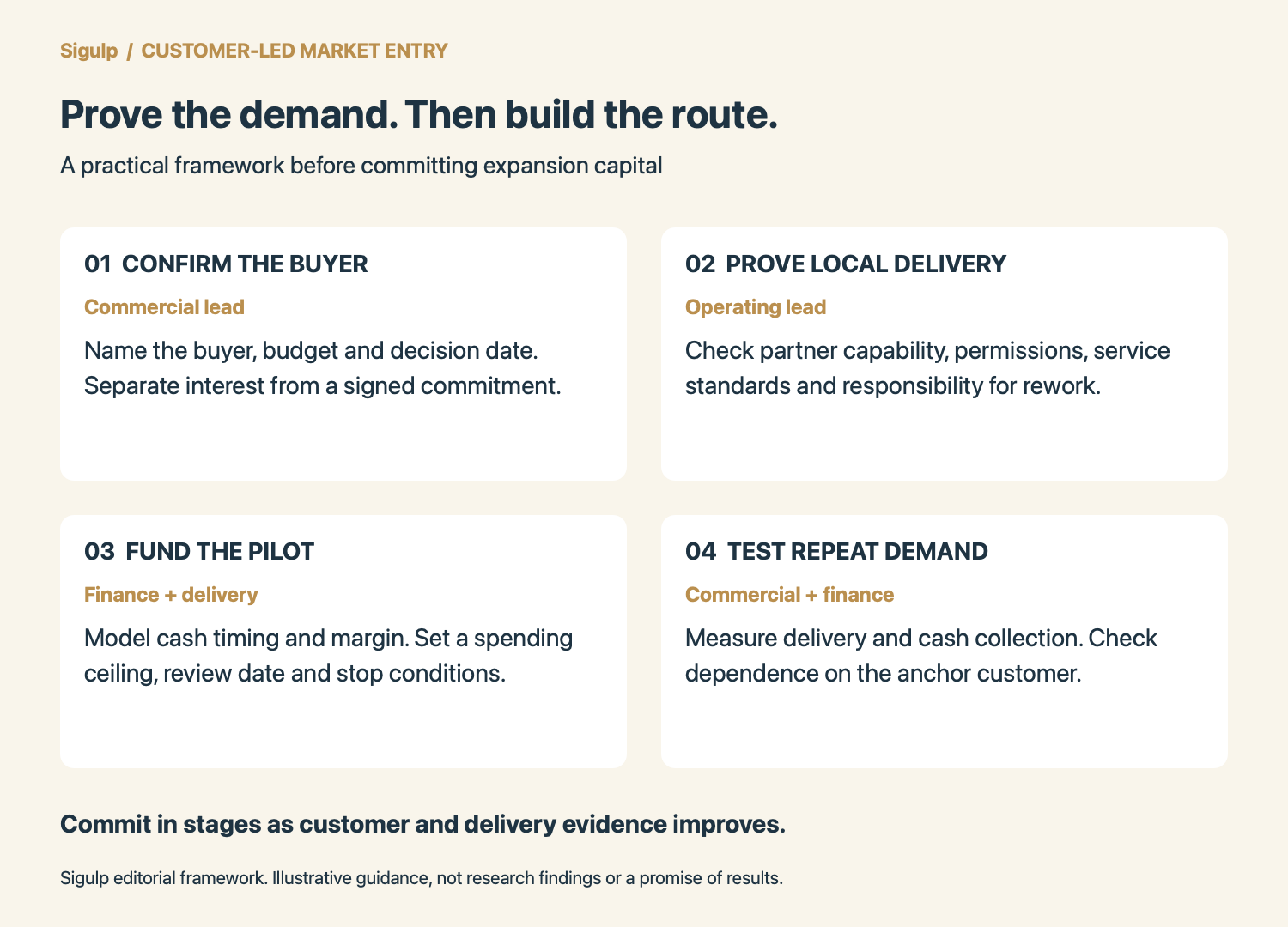
1. Identify demand beyond the first invitation
Over the next fortnight, the founder or commercial lead could interview three existing customers with overseas plans and obtain one local delivery quotation. Look for a repeatable problem that more than one buyer will pay to solve.
Keep introductions, expressions of interest and signed orders separate in the forecast. If only one customer needs the service, assess the opportunity as a dedicated account expansion and price the dependency accordingly.
2. Choose the delivery route with the fewest untested assumptions
Compare remote delivery, partnering, hiring locally and acquiring an existing operation. Consider speed, control, total cost and management effort.
Before relying on a partner, check relevant delivery experience, capacity and references. Agree who owns the customer relationship, handles complaints and carries the cost of rework. Obtain appropriate local advice on contracts, tax, employment and any sector-specific requirements.
3. Calculate the cash needed to complete the work
Build the economics around the proposed order. Include local labour, partner fees, freight where relevant, travel, insurance, compliance work and management time.
Then model when cash leaves and when it returns. A profitable invoice can still require months of funding if suppliers need deposits and customers pay later. Test a realistic downside case: slower payment, weaker demand or a delivery problem requiring another visit.
Set a minimum acceptable margin and a maximum cash exposure before negotiating the launch.
4. Run a bounded, paid pilot
Define one customer problem, a limited scope, a delivery owner and an agreed review date. Set a spending ceiling and decide what evidence would justify the next commitment.
The pilot might cover one installation, one distribution territory or a fixed package of local support. Measure delivery quality, contribution after direct costs, cash collection and the customer’s willingness to purchase again. Then calculate the repeat order volume needed to cover continuing local overhead.
Agree the stop or change conditions in advance. These might include missing permissions, costs above the ceiling or the customer declining to commit to the next phase. Keep fixed commitments small enough that ending the pilot remains practical.
5. Make customer concentration an explicit decision
An anchor customer can make market entry possible. It can also leave the new operation exposed if that customer delays, renegotiates or withdraws.
Calculate how much revenue and committed capacity depend on the account. Ask whether the same team and offer can serve other buyers without substantial redesign. Where possible, align customer commitments with the costs they require you to incur, and build a credible route to additional customers before adding permanent overhead.
Expand when the evidence supports it
CTP’s announcement offers a useful strategic example, but a proposed transaction cannot establish future returns or demand for an unrelated SME’s product. Each business needs its own customer evidence and delivery economics. A locally focused business with no cross-border customer need may have better uses for its capital.
Start with one customer’s credible expansion need and work through the buyer, offer, local delivery and cash requirements. That exercise can reveal a launch worth pursuing, a partnership worth building or a reason to keep serving the opportunity from home.
For businesses assessing that decision, Sigulp’s expansion and market entry services offer an initial market assessment before any commitment to implementation.
Sources and further reading
- CTP, 9 November 2026: proposed acquisition, operating platform and completion conditions.
- Reuters, 9 November 2026, via MarketScreener: reporting on the proposed deal and management’s explanation of customer demand.

Elvijs Plugis is the founder and CEO of Sigulp. His expertise spans business strategy, strategic marketing, communications, partnerships and commercial development. Through Sigulp, he helps organisations connect strategy with practical delivery across marketing, PR and media, partnership development, events, advisory, commercial growth, and digital and AI discovery.
He also serves on the English Chamber Orchestra’s International Advisory Board, is a member of the Conservative Foreign & Commonwealth Council (CFCC), and is Vice Chair of the Parliamentary Society for Arts, Fashion and Sports.