

By Elvijs Plugis, published by Sigulp
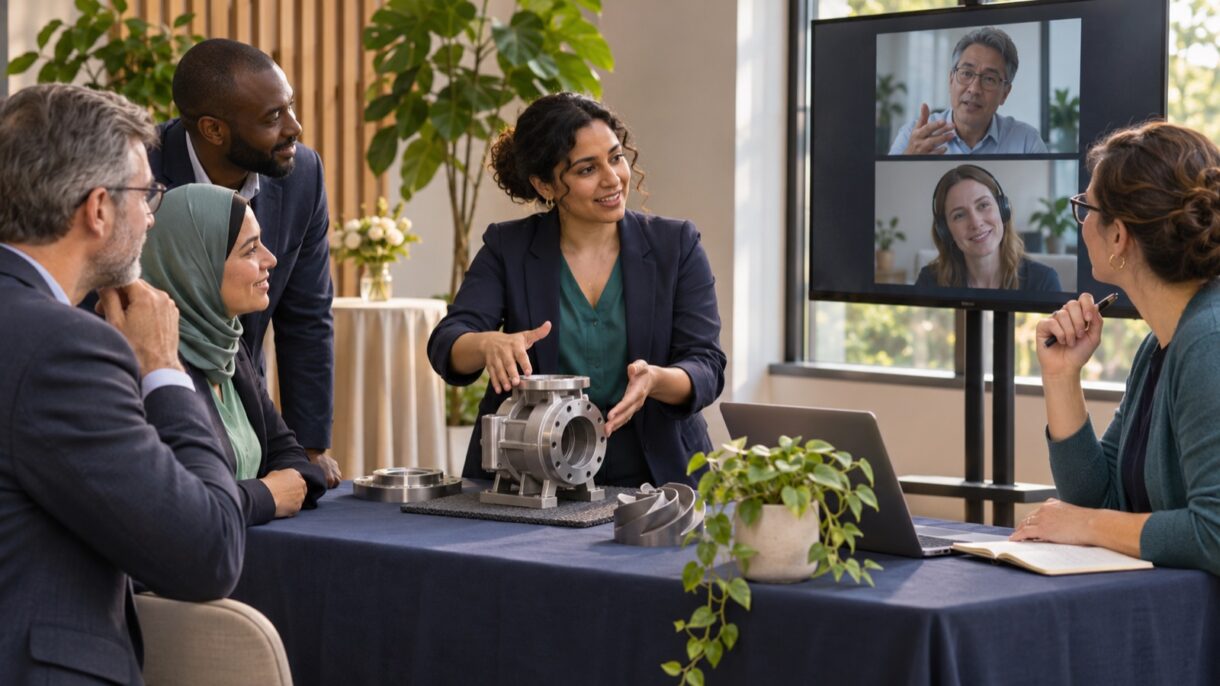
Cover: AI-generated editorial illustration; not a photograph of Yamaha, Disguise or PTC.
An impressive event can still leave the right people outside the conversation. The room looks excellent, the presentation runs smoothly, and the photographs suggest success. Yet an important customer could not travel, a remote participant could not ask a useful question, or the sales team leaves without knowing what anyone needs next.
Before approving more production technology, I would ask which of those problems it is meant to solve. The commercial brief should come before the equipment list. An event earns its place in a growth strategy when it helps a relevant audience understand something, trust the people delivering it and take a worthwhile next step.
Why Yamaha’s announcement matters beyond entertainment
On 13 November 2026, Yamaha announced an agreement to acquire Disguise, the London-based provider of software and media-server technology. Yamaha describes the combination as an expansion from audio into integrated audio, video, lighting and media, alongside its move towards software and services. Completion is expected in December, subject to conditions; the announcement is not evidence of realised commercial benefits.
For businesses planning launches, customer demonstrations or conferences, the interesting point is how these capabilities work together. Clear sound, relevant visual explanation and a useful conversation can support the same customer decision. Buying more of any one component does not automatically improve the experience.
This is especially relevant when the people who influence a purchase are in different locations. A visually sophisticated presentation that excludes a technical decision-maker may achieve less than a straightforward demonstration everyone can question.
A documented case: reaching the customers who could not visit
An older Disguise case study about PTC’s Corporate Experience Center describes a specific audience mismatch. More than half of PTC’s customer base was in EMEA and APAC, but 91% of visits to its Boston centre came from North American customers. Those are different populations, not directly comparable market shares, but they identify an access problem worth investigating.
PTC and its collaborators developed an extended-reality environment supporting two-way conversations and tailored demonstrations. The supplier reports a 40% increase in reach across EMEA and APAC. Its case study does not provide the underlying counts, measurement period or a controlled comparison. That figure should therefore be treated as a vendor-reported outcome, not a forecast for another business or proof of additional profit.
The useful lesson is the sequence: identify who is missing, understand what they need to experience, then choose a way for them to participate. The case is background material available in a 2023-hosted document, not a result of the proposed acquisition announced on 13 November.
Design for a decision, not just attendance
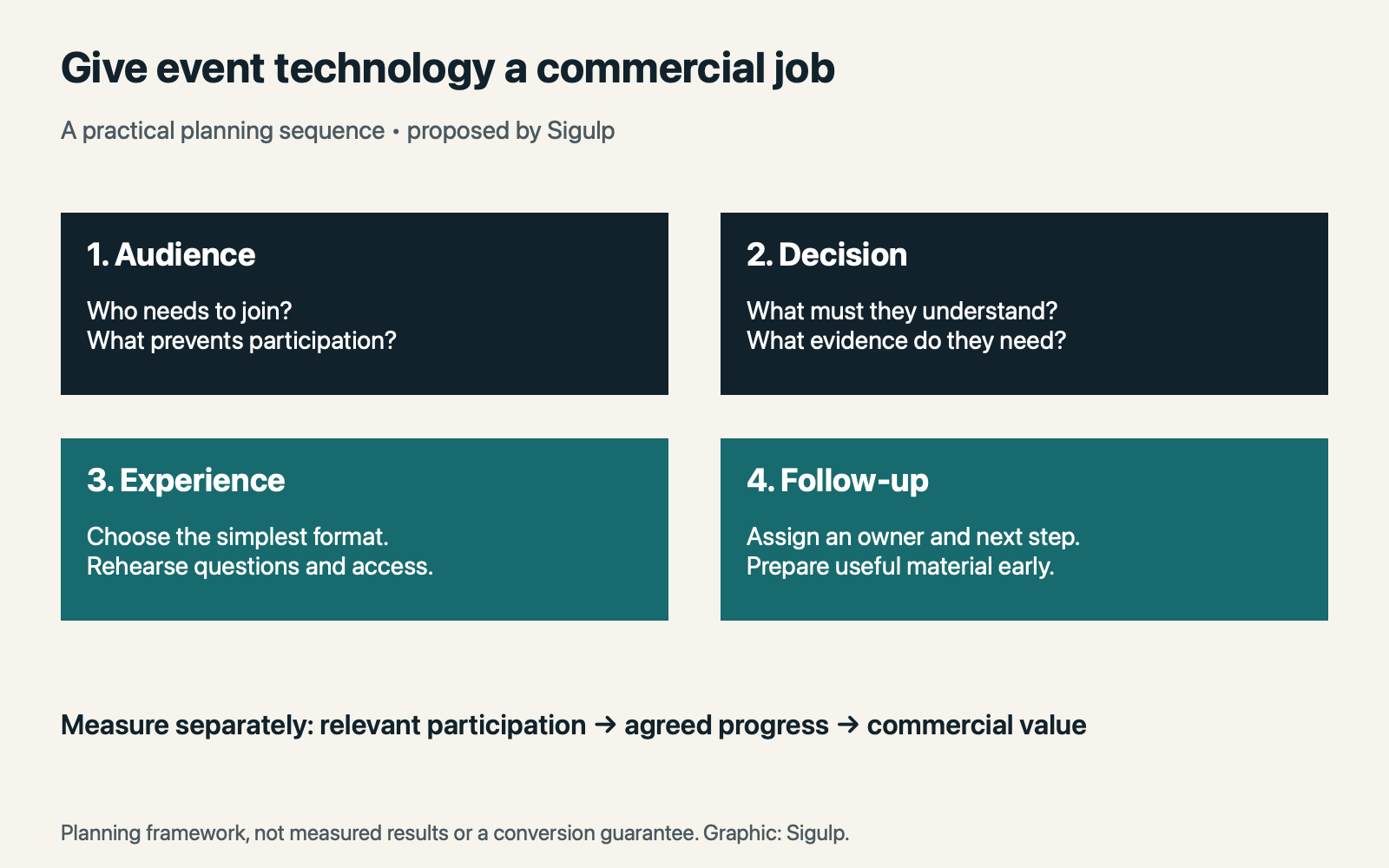
Start by naming one decision the event should help someone make. A prospective distributor might need confidence that a product can be supported locally. An engineering buyer may need to see how it works in their operating environment. A potential sponsor may need to understand the audience and the programme they would support.
Ask the commercial lead to speak with three to five intended participants before the brief is finalised. What is difficult to assess remotely? Who else needs to be involved? What would make attendance worth their time? These conversations are exploratory, not representative research, but they can prevent an expensive answer to the wrong question.
Then write the event promise in ordinary language. “Understand whether this system fits your current workflow” is more useful to a buyer than a promise of an unforgettable immersive experience. Production choices can now be assessed against that promise.
Test the smallest useful format
A small business rarely needs a permanent studio to find out whether remote participation helps. A quiet room, clear microphone, reliable connection, a physical sample and a skilled facilitator may be enough for a first test. Rent specialist production only where it resolves an identified problem that simpler tools cannot.
Give one person responsibility for remote participants rather than asking the presenter to manage every question and technical issue. Rehearse the actual interaction: can someone interrupt, see the relevant detail and hear the answer? Include captions or other accessibility support appropriate to the audience. Test the fallback as well as the ideal experience.
Compare the full cost of the trial, including preparation, staff time, delivery and follow-up, with a conventional format. Reduced travel can be useful, but an elaborate production can introduce different costs. Neither format wins automatically.
Plan the material that survives the event
Decide before delivery which demonstrations, explanations and questions deserve to become useful follow-up material. Arrange the relevant recording permissions, avoid exposing confidential customer information and brief the editor on what each asset should help the viewer understand.
Within two working days, the account owner could send an agreed technical explanation, a short demonstration extract or a relevant next-step proposal. This is an operational target for the team, not a claim that a particular response time guarantees conversion. A long unedited recording often transfers the work of finding the useful part back to the customer.
Measure access and progress separately
For the first two events, record which intended decision-makers participated, which questions remained unresolved and which next steps were explicitly agreed. Track preparation and delivery costs alongside qualified opportunities and eventual contribution. As discussed in our guide to connecting marketing results to business benefits, attendance is an activity measure; a meeting is progress only if it advances a real decision.
Continue when the format brings relevant people into a conversation they could not otherwise join and produces worthwhile follow-up. Simplify it if production absorbs the team while customer questions remain unanswered. Keep an in-person format where physical inspection, sensitive discussion or relationship building makes it more suitable.
At Sigulp, the commercial question connects events, media and business development: who needs to understand what, and what happens afterwards? Technology is valuable when it makes that answer easier to deliver.

Elvijs Plugis is the founder and CEO of Sigulp. His expertise spans business strategy, strategic marketing, communications, partnerships and commercial development. Through Sigulp, he helps organisations connect strategy with practical delivery across marketing, PR and media, partnership development, events, advisory, commercial growth, and digital and AI discovery.
He also serves on the English Chamber Orchestra’s International Advisory Board, is a member of the Conservative Foreign & Commonwealth Council (CFCC), and is Vice Chair of the Parliamentary Society for Arts, Fashion and Sports.